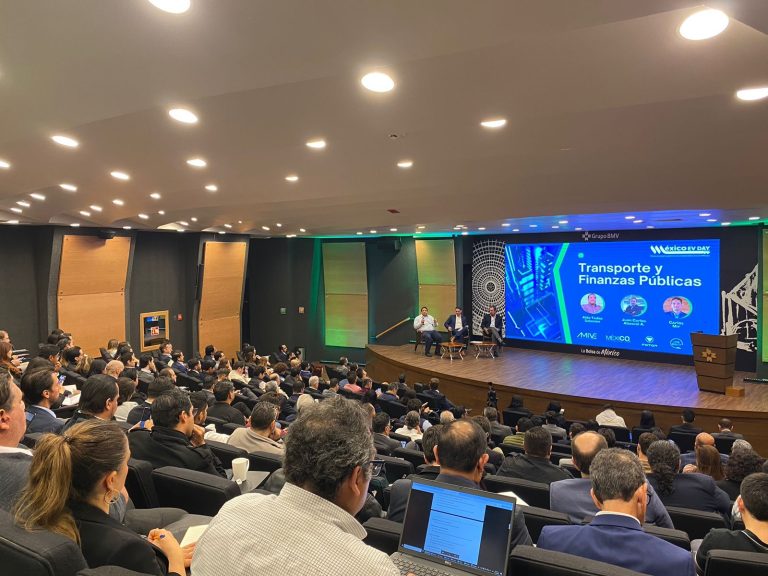

On March 26, 2026, AMIVE took part in a key industry webinar titled “Diagnosis Towards a Roadmap for the Orderly Deployment of Electric Vehicle Charging Infrastructure.”
The session brought together government officials, industry experts, and private sector stakeholders to discuss the current state of electric mobility in Mexico, along with the challenges surrounding the development of EV charging infrastructure.
Electric mobility in Mexico: a transition already underway
The shift toward electric mobility in Mexico is no longer theoretical—it has already begun, albeit at an early stage.
Today, transport accounts for a significant share of the country’s energy consumption, yet electricity represents only a very small portion of that demand. This highlights both the gap and the opportunity for scaling electric transport in Mexico.
At the same time, the adoption of electric vehicles (EVs) is becoming increasingly important for meeting the country’s climate targets.
Growth of electric vehicles in Mexico
The market for electric vehicles in Mexico is showing clear signs of expansion.
Sales of battery electric vehicles (BEVs) and plug-in hybrid vehicles (PHEVs) have been growing steadily, with strong growth rates and positive outlooks toward 2030.
That said, overall penetration remains relatively low compared to the size of the total vehicle market—pointing to significant room for growth.
EV charging infrastructure in Mexico: the main bottleneck
One of the central themes of the webinar was the development of EV charging infrastructure in Mexico, widely seen as a critical enabler for further adoption.
While the number of charging stations has increased, several challenges remain:
- Uneven geographic distribution
- Early-stage development led primarily by the private sector
- Limited public charging infrastructure
- More complex technical requirements for heavy-duty transport
Without a well-planned and sufficiently scaled charging network, EV adoption will struggle to accelerate at the pace required.
Public transport and logistics: where adoption is accelerating
The growth of electric mobility in Mexico is not happening uniformly across all segments.
So far, the strongest momentum can be seen in:
- Public transport in selected cities
- Urban logistics and last-mile delivery
- Corporate and private fleets
In particular, freight and logistics stand out as high-potential segments due to their predictable operating patterns, which make electrification more viable.
Regulation and planning: the need for a national strategy
Mexico has already made progress in building a regulatory framework for electric mobility, including rules governing the integration of charging infrastructure and its connection to the power grid.
However, a key takeaway from the discussion is that the next phase will require stronger coordination and long-term planning.
In this context, the development of a national roadmap for EV charging infrastructure will be essential to:
- Guide the sector’s growth
- Align public and private investment
- Anticipate impacts on the power system
AMIVE’s role in advancing electric mobility in Mexico
AMIVE’s participation in this webinar reflects its active role in shaping the future of electric mobility in Mexico.
The association continues to support:
- Collaboration between public and private stakeholders
- The development of standards and best practices
- The structured expansion of charging infrastructure
- The adoption of electric vehicles across the country
What’s next for electric mobility in Mexico
The diagnosis presented during the webinar confirms that electric mobility is no longer a future trend—it is already taking shape.
The real question now is not whether Mexico will transition to electric transport, but how quickly and how effectively that transition can be scaled.
In that process, charging infrastructure, regulation, and coordination across stakeholders will be critical.